Beverage / Success case
$1.5M beverage pre-seed: investor deck and financial model
A functional energy drink brand had a great product, early sales and a model full of unit economics, but no scenario a VC could get excited about. We rebuilt the deck and the model for a crowded category.
At a glance
Pre-seed closed
$1.5M
For a US functional energy drink brand.
- First runSold out
- Pilot marketsDistributors reordering
- $1.5M pre-seedClosed
- National distributionNext
Gross margin path
From about 30% to 60%+
Through volume, better supplier terms and production efficiency
The new deck
Traction first
The product explains why it sells, the market why it can scale
Client
US functional energy drink brand
- Functional drinks
- Energy drinks
Scope
- Narrative
- Investor deck
- Deck design
- Financial model
The challenge: a crowded shelf, real traction and a model with no upside
The market. Energy drinks are one of the most crowded shelves in retail. Two brands hold about 70% of the US market, and new brands live or die on distribution.
The stage. Investors want traction before they write a cheque. The company had it: early revenue, a sold-out first production run, and distributors reordering.
The model. The founders knew their unit economics inside out, but the model stopped there: case-level detail, no big picture, no scenario a VC could get excited about.
The story: an energy drink people can have every day
A great product with real early sales, a model full of unit economics, and no answer to the question every VC asks: how big can this get?
The founders knew their unit economics inside out, but the model stopped at case-level detail. Nothing showed an investor what the brand becomes at scale.
An energy drink people can have every day: real fruit, less caffeine and less sugar, in a huge category still built on sugar and synthetic caffeine.
Already proven on the ground, with distributors reordering and the first run sold out. The plan takes it to national distribution with margins doubling as volume grows, in a category where functional brands have sold for billions.
What we learned: why beverage brands struggle to raise
Consumer investors know the category’s numbers before the first meeting.
- ~70% of the US energy drink market is held by two brands
- $16B+ in energy drinks sold through US convenience stores in 2025, and getting in takes distributors
- 50-100 stores, or a few hundred thousand in revenue, before early-stage investors consider a cheque
- 35% gross margin is now the bar: investors want growth and a path to profit
What gets funded, and how the deck shows it
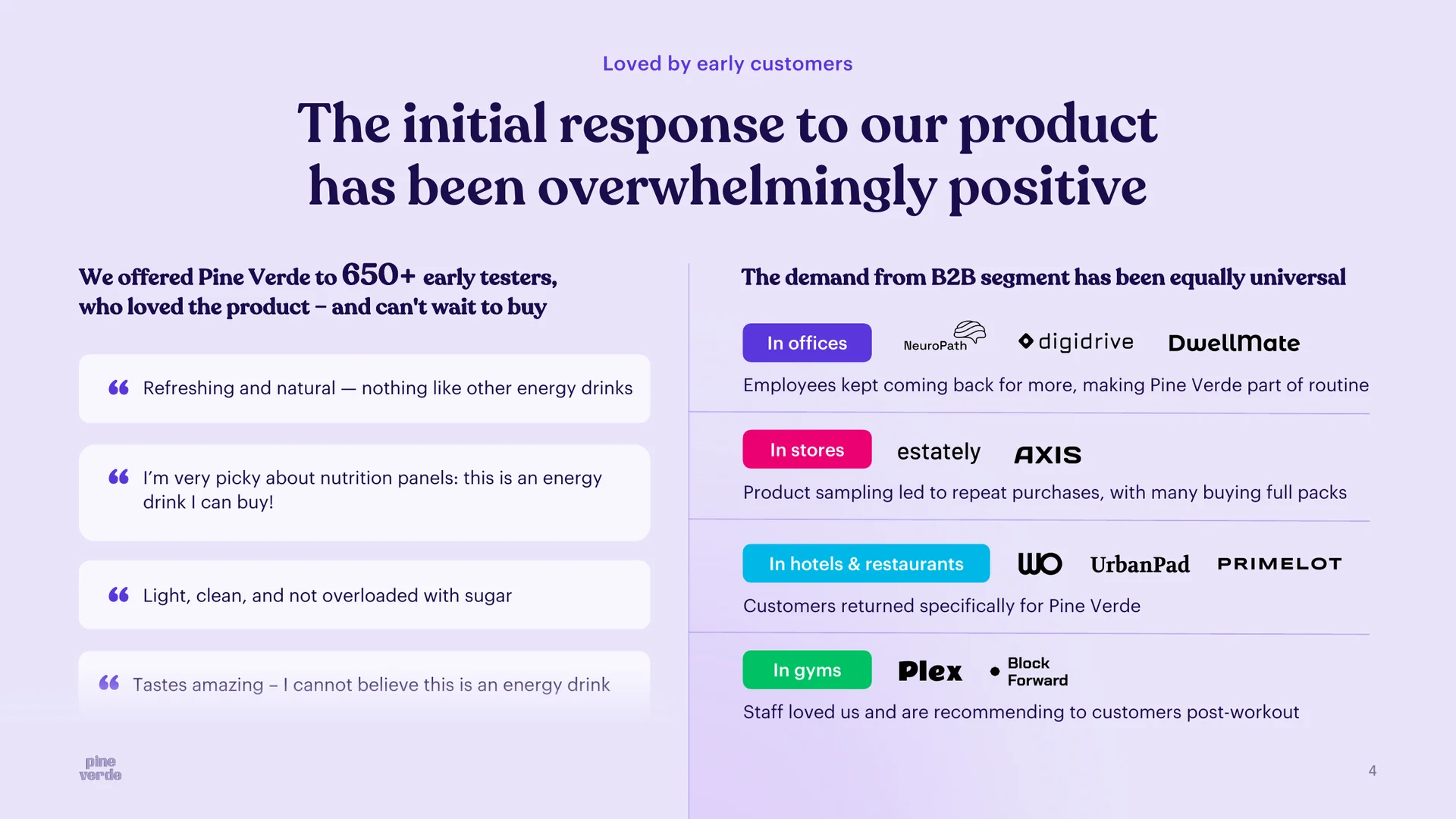
The deck leads with traction, because in this category investors won’t move without it.
Stores and sales speed.
Proof the product sells off the shelf: early revenue, reorders, and demand from offices, stores, hotels and gyms.
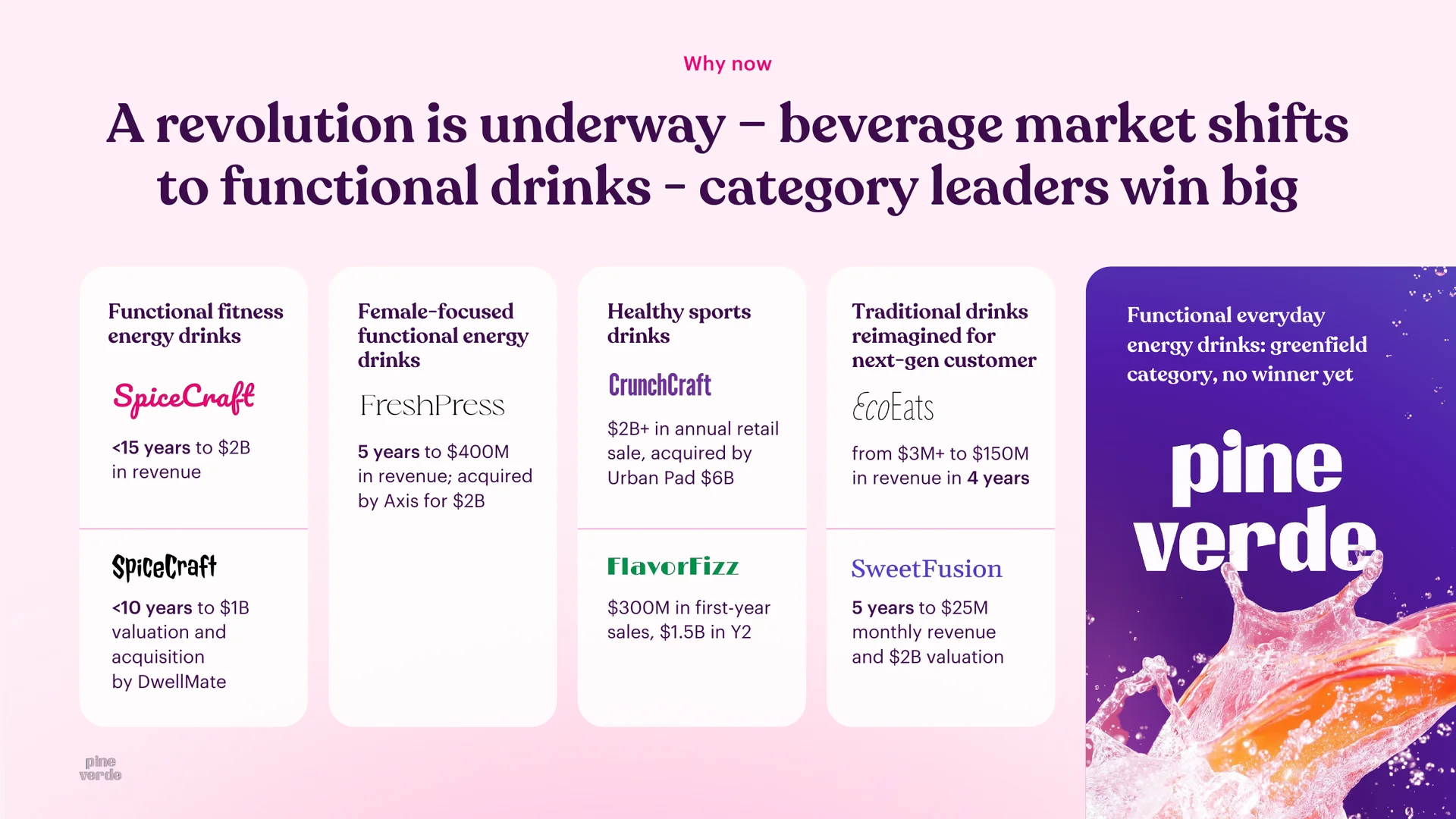
A scenario big enough for a VC.
Functional drinks brands sell for billions: PepsiCo bought a five-year-old prebiotic soda brand for $1.95B in 2025.
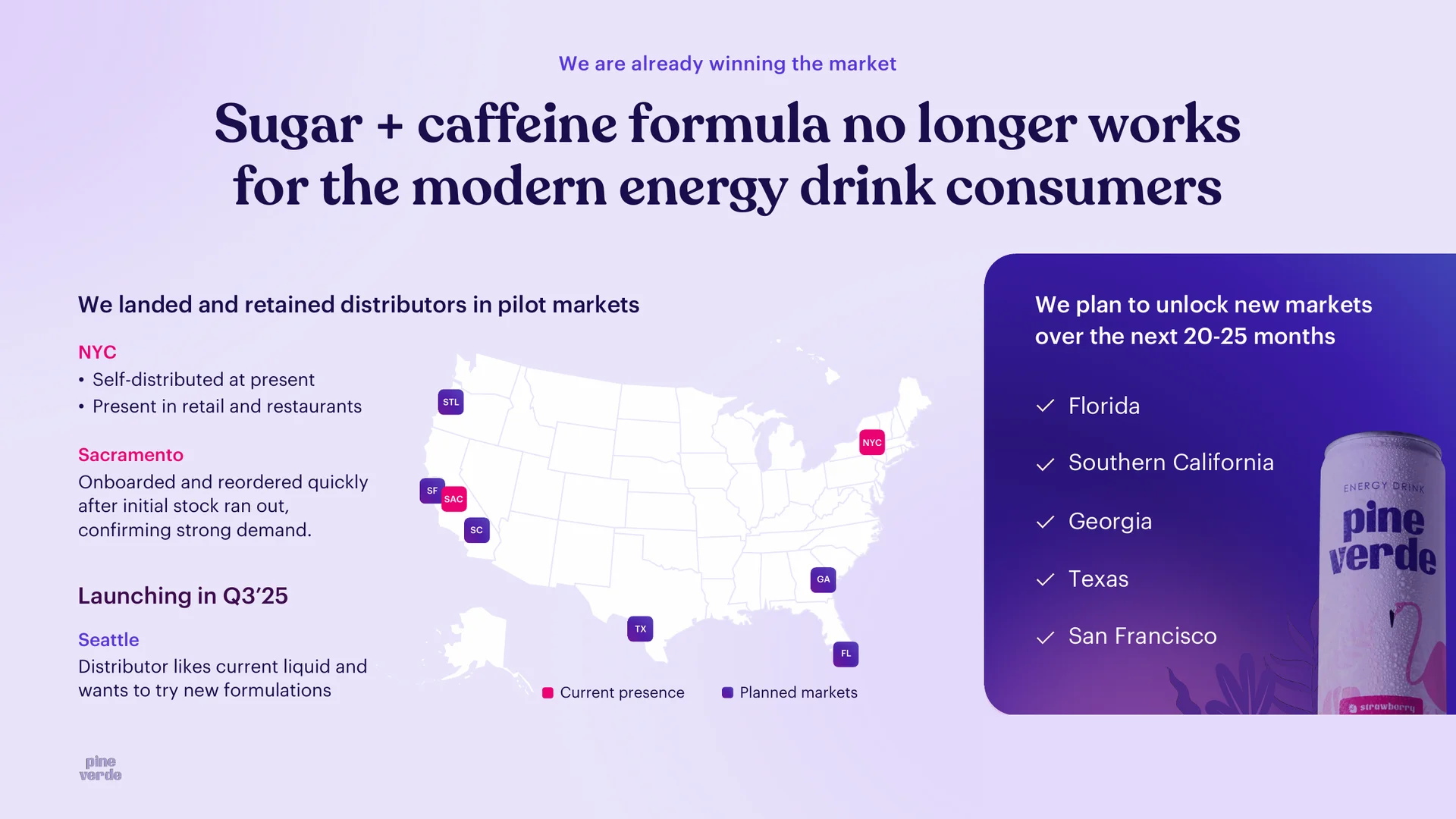
A distribution plan with a clear order.
Market by market and distributor by distributor, from today’s pilot markets to the ones that come next.
What we did: the deck and the model
We rebuilt the deck and the model for a crowded category.
Narrative
The brand in the gap the leaders leave: an energy drink people can have every day. Traction first, then product, then market.
Traction story
Early revenue, a sold-out first run, distributors reordering, and demand from offices, stores, hotels and gyms.
Distribution plan
The expansion market by market, with distributor targets and the channels that come next.
Financial model
The founders’ unit economics as the foundation, with the growth engine and a VC-sized scenario on top.
Design
Bold, colourful and on brand, so the deck looks as good as the can.
The margin path: how gross margin doubles
The model shows where today’s margin goes as the brand scales, and what moves it.
- Volume
- Better supplier terms
- Production efficiency
Results
- $1.5M pre-seed closed
- 60%+ gross margin path in the model, from about 30% today
- VC-sized upside, built on unit economics the founders already trusted
- A deck that led with traction, in a category where investors won’t move without it
The investor deck









 $10MSeries A
A $10M Series A round for a beverage company
3 term sheets14-day revampRead the story $500Kpre-seed
$500K pre-seed raise for a beauty brand
Oversubscribed in 3 weeksRead the story $1.7Mseed
Pitch deck that raised $1.7M for a vegan restaurant chain
Read the story £3Mdebt raise, in market
Building the £3M debt deck for a live entertainment company
Sold-out London debut2027 UK and Europe rolloutRead the storyBuilding a consumer brand in a crowded category?
We build the deck and the model that turn early traction into a funded round.

