Industry: Retail
Retail startup funding
Store-led brands, specialty chains and franchise systems raise money one location at a time. We help you prove that each store pays back, and show it to the investors who fund stores.
- Market data and investor types for stores, chains and franchises
- Decks and models built store by store, from payback to roll-out
- Waveup prepares investor materials for retail companies: $3B+ raised for 600+ startups since 2014
In short
What is retail startup funding?
Retail startup funding is the capital store-led brands, specialty chains, franchise systems and roll-ups raise to open or buy locations. It comes from angels, consumer VCs, private equity, franchise investors and lenders. PitchBook tracked only $396M of retail VC deals in 2025, so most money now follows proven store economics.
- Who it's for
- Store-led brands, specialty chains, franchisors and multi-unit operators, pre-seed to Series D+
- What we build
- Investor deck, financial model, extended CIM, valuation, investor list
- Prices
- Deck from $6,000, model from $3,000. Flat fees
- Track record
- $3B+ raised for 600+ startups since 2014
Market data checked on 6 November 2026. Sources are under each section.
Why do store businesses need a different kind of investor?
Venture funds have pulled back from retail, so most capital now comes from private equity, franchise investors and lenders. They fund what one store proves: steady profit, then more stores like it.
The opportunity
Specialty shops are outgrowing retail as a whole, and franchising gives proven concepts a way to spread.
- Franchise systems keep adding retail units
- Smaller stores, kiosks and shared spaces cut the cost of opening
- Private equity likes franchising's steady royalty income
The problem
Retail drew $7.6B of venture deals in 2021, by PitchBook's count, and only a sliver of that in 2025. Banks have also tightened their standards for loans to small firms.
Market size
How big is US retail, and which store formats are growing?
US retailers sold $5.64 trillion of goods from January to September 2026, by the Census Bureau's count. That was 4.8% more than a year earlier. Four shifts decide which store businesses attract money now:
- Specialty shops: sales at Census's 'miscellaneous' stores, from florists to pet shops, rose 11.2% over those nine months
- Franchise growth: retail franchise units are forecast to grow 2.3% in 2026, faster than franchising overall
- Cheaper units: two-thirds of franchise brands launched in 2025 cost under $500,000 to open a unit
- Pharmacies and health stores: their sales fell 1.9%, while most store types grew
Venture capital
How much venture capital reaches retail now?
PitchBook tracked $396M of VC deals in retail in 2025, to 19 December. Most of the larger rounds went to online businesses, but a few brick-and-mortar stores raised too.
fall in retail VC from 2021 to 2025, our arithmetic on PitchBook's two figures
fund closed by Princeton Equity in September 2026 for franchisors and multi-location businesses
early-stage round for AGCF in February 2025, after it opened its first boutique in Beverly Hills
Who invests in retail startups?
Consumer private equity, franchise specialists, a growth investor and an asset-based lender. For retail VCs by name, see our list of retail investors and VCs. Franchisees often borrow instead: SBA-backed 7(a) loans go up to $5M. Shops can also raise from customers: Regulation Crowdfunding allows up to $5M in 12 months.
Investor database
E-commerce and retail investors in our database
The funds with the most e-commerce investments. Pick a stage, or open a fund for its cheque sizes.
Top 5 by e-commerce investments
Investments by industry
- CleanTech & Sustainability15%
- E-commerce & Retail15%
- Fashion & Apparel15%
- Rounds
- Pre-seedSeedSeries ASeries B
- Average cheque
- $500K–$1M$1M–$3M$3M–$10M
- Based in
- Santa Barbara, United States
- Invests in
- USA
19 investments in total, 7 tagged E-commerce & Retail.Open the full fund profile
Investments by industry
- Fintech & Financial services36%
- Software & Apps20%
- E-commerce & Retail8%
- Rounds
- Pre-seedSeedSeries ASeries BSeries C+
- Average cheque
- $0–$100K$100K–$500K$500K–$1M$1M–$3M$3M–$10M
- Based in
- San Francisco, United States
- Invests in
- USA
192 investments in total, 7 tagged E-commerce & Retail.Open the full fund profile
Investments by industry
- Fintech & Financial services39%
- Software & Apps26%
- E-commerce & Retail8%
- Rounds
- Pre-seedSeedSeries ASeries C+
- Average cheque
- $500K–$1M
- Based in
- Berlin, Germany
- Invests in
- Israel, MENA, LatAm +5
995 investments in total, 6 tagged E-commerce & Retail.Open the full fund profile
Investments by industry
- Software & Apps29%
- E-commerce & Retail6%
- Food & Beverage6%
- Rounds
- Pre-seedSeedSeries ASeries B
- Average cheque
- $100K–$500K$500K–$1M$1M–$3M$3M–$10M
- Based in
- San Francisco, United States
- Invests in
- USA
256 investments in total, 4 tagged E-commerce & Retail.Open the full fund profile
Investments by industry
- E-commerce & Retail43%
- AI & Deep Tech29%
- Social media14%
- Rounds
- Pre-seedSeedSeries A
- Average cheque
- $0–$100K$1M–$3M$3M–$10M$10M–$50M
- Based in
- New York, United States
166 investments in total, 3 tagged E-commerce & Retail.Open the full fund profile
From our investor database.
What stops investors funding a new store concept?
In our Fundraising 2025 study, 56 VCs named their reasons to say no. Top of the list: revenue growth, unit economics, burn and missed milestones, then defensibility and crowded categories. For store businesses, four questions come first.
Payback for every store
FRANdata expects its franchise unit success rate to slip to about 94.2% in 2025. It was 95.9% in 2021.
What investors ask
- How long does a new store take to earn back what it cost to open?
What your deck shows
- Four-wall profit and payback for each store, by opening year
- Second-year sales of each store against its first
Tighter credit
In the Fed's October 2026 survey, 6.8% of the banks polled had tightened standards on loans to small firms. FRANdata says tighter credit limits what franchise systems can invest.
What investors ask
- How much of the roll-out can debt pay for, and at what cost?
What your deck shows
- Debt service set against store cash flow
- Which openings lenders will fund and which need equity
The franchise disclosure document
Franchisors must hand buyers their disclosure document at least 14 days before they sign or pay. Any claim about sales or profits has to sit in Item 19.
What investors ask
- What do your franchisees earn, and does Item 19 show it?
What your deck shows
- Sales and profit from your own franchise units
- Royalty income per unit, and units sold but not yet open
Debt in roll-ups
Franchise Group, which ran Pet Supplies Plus, carried too much debt, GlobalData's Neil Saunders said. It spent seven months in Chapter 11, sold The Vitamin Shoppe and shut its American Freight chain.
What investors ask
- Can the group pay its debt if same-store sales fall for a year?
What your deck shows
- Leverage tested against a year of weaker same-store sales
- Results for each brand since you bought it
How we help you raise
Flat fees agreed before we start. No success fee on advisory work.
Your concept's story, told through store economics and the roll-out plan.
Openings, four-wall profit and cash needs, store by store and month by month.
A defensible range built on comparable chain and franchise deals.
Consumer VCs, franchise investors, private equity and lenders that fit your stage.
Leases, store P&Ls and franchise papers, organised for diligence.
An extended CIM for investors, or the pack for a roll-up or a sale.
 $1.7Mseed

Pitch deck that raised $1.7M for a vegan restaurant chain
Read the story $12Mseed

The pitch deck that raised $12M seed round
Read the story £3Mdebt raise, in market

Building the £3M debt deck for a live entertainment company
Read the story $10MSeries A
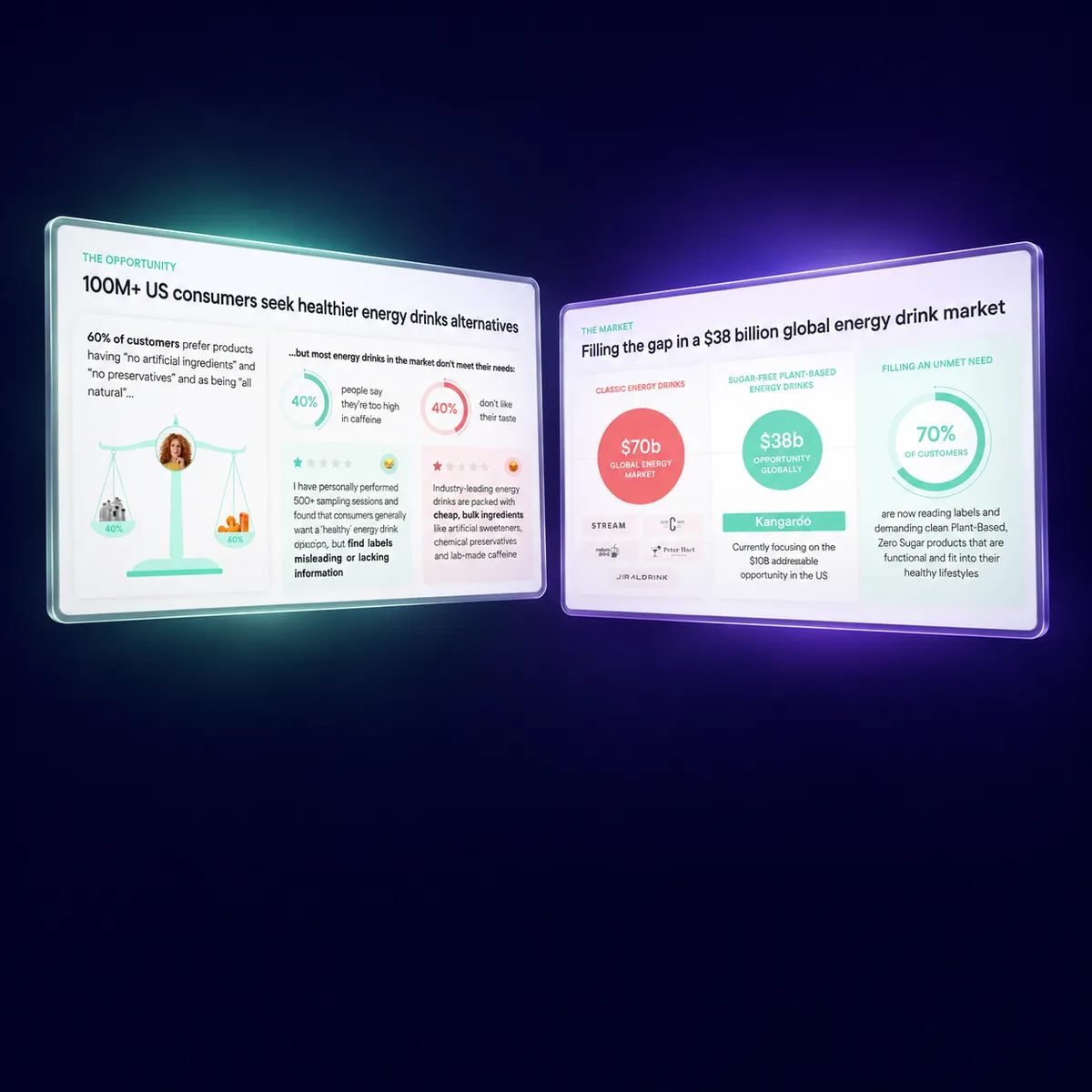
A $10M Series A round for a beverage company
Read the storyWho we are
Waveup is a London-based fundraising and growth advisory, working in 60+ countries and 90+ industries. Since 2014 we have built the decks, models, CIMs and valuations behind $3B+ raised for 600+ startups. We prepared the investor materials for a vegan restaurant chain's $1.7M seed round.
About usRetail startup funding FAQ
How do retail startups get funding?
Do venture capitalists invest in retail stores?
How do franchises get funding?
What do investors look for in a retail business?
Can a retail brand raise money from its customers?
How much does help with a retail raise cost?
Raising for a retail company?
Tell us how many stores you run and what the next openings will cost. We'll show you the numbers investors will ask for.

